Varieties · 5 min ·
Heirloom is not a variety. Ethiopia's coffees have names.
Why heirloom tells you almost nothing about an Ethiopian coffee, what JARC numbers and landrace names tell you instead, and what is in the Ethiopian coffees we roast.
Gabriel KaramoyBSD City

In this note · 6
"Heirloom" on a bag of Ethiopian coffee does not name a variety. It is a catch-all for coffee whose variety was not, or could not be, identified. Behind it sit two kinds of coffee that do have names: landraces that producers have kept and shared for generations, such as Kurume and Wolisho, and the numbered selections of Ethiopia's Jimma Agricultural Research Center, such as 74158.
Arabica grows wild mainly in the forests of south-west and southern Ethiopia, and an Ethiopian farm often grows a mix of coffee types side by side. A 2022 genetic study of coffee grown across Ethiopia and Yemen sorted it into six groups. Most of the varieties planted around the world, from Typica and Bourbon to SL28 and SL34, descend from just two of them. Two others, which the authors call Core Ethiopian, were found in Ethiopia and nowhere in Yemen.
Why "heirloom" is the wrong word
An heirloom is something a family keeps and hands down. Getu Bekele, an agronomist who bred and studied coffee at JARC for many years, wrote A Reference Guide to Ethiopian Coffee Varieties with Tim Hill of Counter Culture Coffee. He puts it plainly: in Ethiopia "there is not a single coffee variety which is owned by a specific family and passed down over several generations". A farm holds a mix of varieties, and seed is shared among producers across a wider area. Bekele prefers "landrace", which "is not bounded by the concept of time and ownership".
Bekele and Hill also point out that "heirloom" leaves the impression that no scientific or agricultural progress has been made. Ethiopia has run a national coffee breeding programme since 1971.
The numbered coffees
In the early 1970s coffee berry disease, a fungus that attacks the green cherries on the branch, spread through Ethiopia's coffee. Between 1973 and 1987 the Jimma Agricultural Research Center, JARC, which coordinates the national programme, collected 868 trees that appeared to resist the disease and tested them, and it released the first resistant selections at the end of the 1970s.
Their names are catalogue numbers. 74110, 74112 and 74158 were all selected from mother trees around Metu, in Illubabor, in the west of the country, and released in 1979 for their resistance to the disease and their yield. All three grow as compact trees. In a trial published in 2015, which compared seven early releases at three research stations, 74158 had the highest cup score, though the trial could not separate it from 74110, 74112 or 74140. By 2023 JARC counted about 44 released varieties: 35 pure-line selections and 9 hybrids.
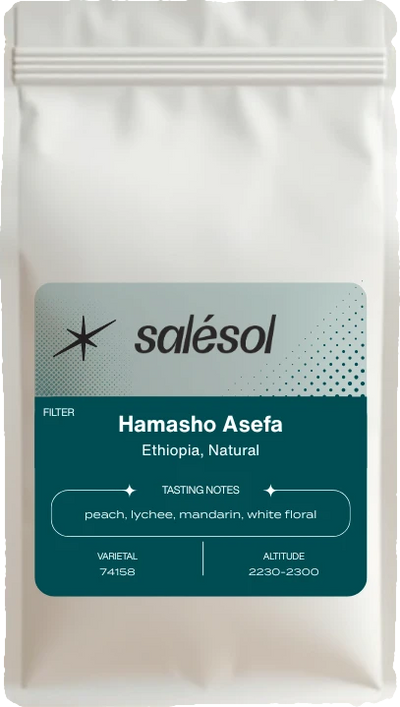
The seed travelled. The 74158 in our Hamasho coffee was selected in Illubabor, in the west, and grows in Bensa, in Sidama, in the south.
The named coffees
A landrace is a population of coffee selected by producers over generations rather than bred by a programme. Ethiopia's have local names, and many come from the native trees the coffee grows among; Kurume is one. These names are passed on by producers rather than registered by breeders, so they describe a type rather than a certified line.
The importer Cafe Imports describes Kurume, also written Kudhumi, as a smaller-size landrace; Wolisho as a tall tree with large fruit, common in the Gedeo zone; and Dega as a high-altitude landrace, also found in Gedeo. That is already more than "heirloom" tells you.
What the DNA shows
Genetics is starting to sort what the names cannot. The 2022 study was led by Christophe Montagnon of RD2 Vision, with Qima Coffee, the Jimma Research Center, the Alliance for Coffee Excellence and the Ethiopian Coffee and Tea Authority. Its 356 Ethiopian samples came from coffees entered in Ethiopia's Cup of Excellence in 2020 and 2021: coffee that is farmed and sold, not trees from the wild forest.
The two Core Ethiopian groups came almost entirely from the south-west and south of the country, and they barely follow geography. The authors suggest that seed moved between regions for large new plantings over the past sixty years and blurred whatever pattern there was. A third group, which they call Ethiopian Legacy, was found in Ethiopia mainly in Gedeo, Guji and Sidama. It links the coffee that stayed in Ethiopia to the coffee that left for Yemen and, from Yemen, for the rest of the world. A fourth, from Hararghe in the east, had never been described before and probably descends from coffee brought back from Yemen. The last two, Typica/Bourbon and New-Yemen, were almost all in Yemen.
For comparison, the authors added four Ethiopian coffees now grown outside Ethiopia: Gesha, Chiroso, Pink Bourbon and SL-06. All four fell into the Core Ethiopian groups, with the coffee that never left.
Reading an Ethiopian label
A variety line that names something, such as 74158, Kurume or Wolisho, tells you which trees the coffee came from. "Mixed landraces" is honest when the cherry comes from many small farms. "Heirloom" tells you only that the coffee is Ethiopian. The washing station, the producer and the altitude tell you the rest.
The Ethiopian coffees we roast
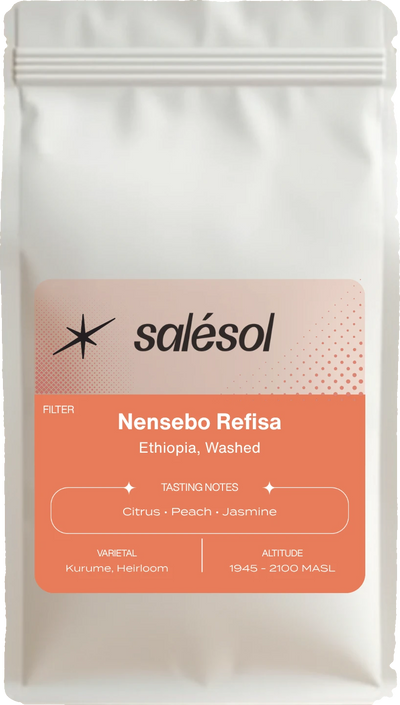
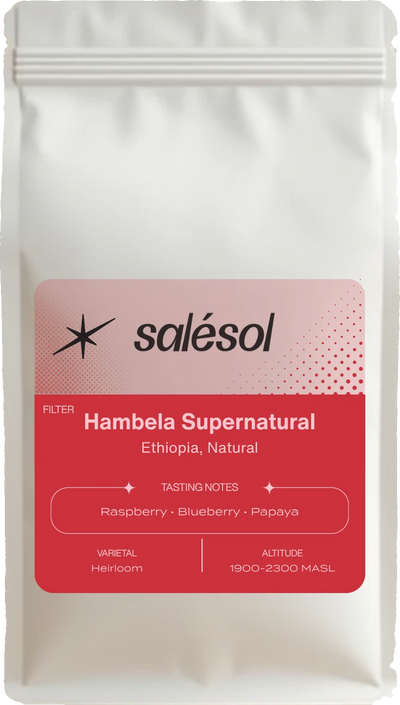
Our own labels use the word too, in the same sense. Hambela's variety line reads "Heirloom". Nensebo Refisa's reads "Kurume, Heirloom": the lot mixes Kurume with trees whose variety has not been identified. Here is what we know about what is in each bag.
- Hamasho Village Asefa, JARC 74158. A natural from Daye Bensa's Hamasho station in Bensa, Sidama. Asefa Dukamo Korma owns the station, and 161 producers and suppliers bring it their cherry. It dries whole on raised beds for 16 to 20 days.
- Nensebo Refisa, Kurume and other landraces. A washed coffee from the Refisa station in Nensebo, West Arsi, at 1,945–2,100 metres, where about 588 smallholder farms bring their cherry. Citrus, peach, jasmine.
- Hambela Supernatural, local landraces. From smallholders in Hambela Wamena, Guji, at 1,900–2,300 metres, who farm one to two hectares each. The whole cherries ferment briefly before they dry. Raspberry, blueberry, papaya.
We roast all three light, for filter. On a V60 the washed Nensebo takes hotter water, 17 g of coffee to 270 g at 93–94 °C, than the two naturals, 17 g to 260 g at 91–92 °C. Give any of them at least 7 days from the roast date, then taste how it changes.
The fourth Ethiopian on our shelf is Gesha Village 1931, a selection the farm made from seed it gathered in the nearby Gori Gesha forest, chosen for its likeness to the Gesha that went to Panama. We wrote separately about why Panama's Gesha costs what it does.
Sources: Sprudge, with Getu Bekele · Daily Coffee News on Bekele and Hill's guide · Beksisa and others, JARC, 2023 on Ethiopia's breeding programme · Tirfe, Kufa and Mohammed, 2015 · Sucafina and Sey Coffee on the Metu selections · Cafe Imports on landrace names · Montagnon and others, 2022